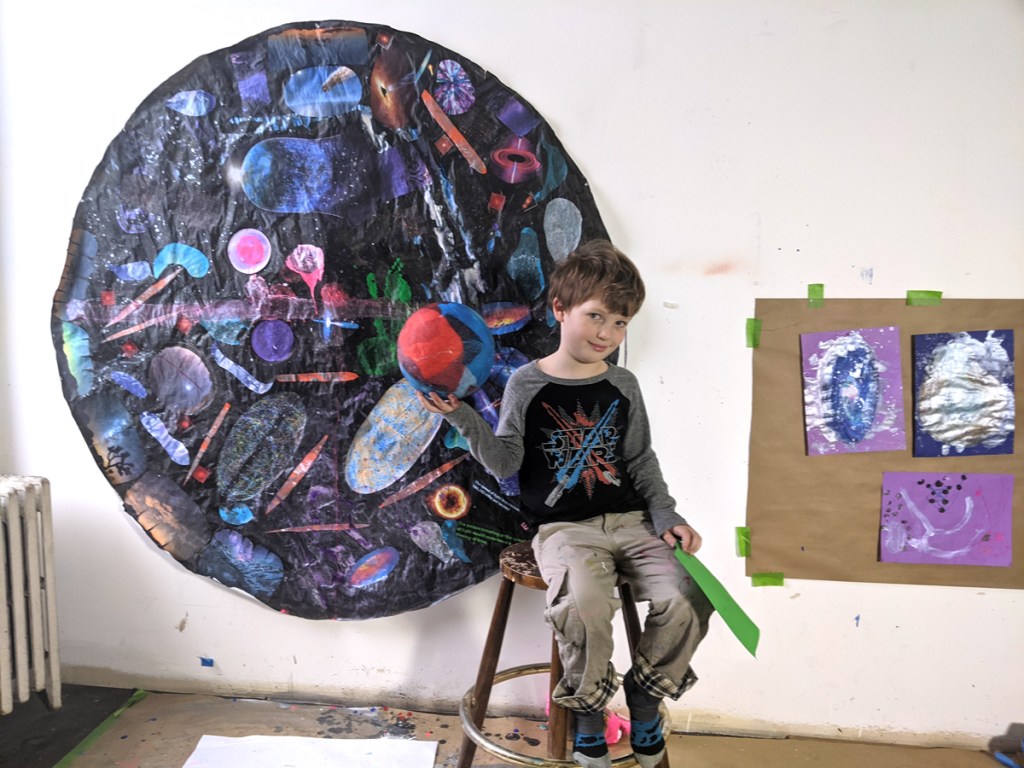
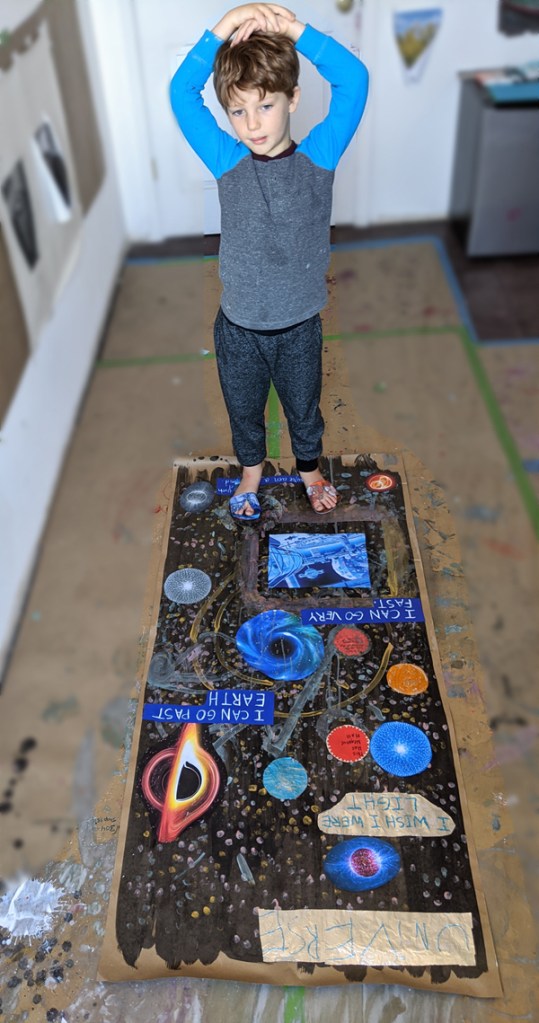
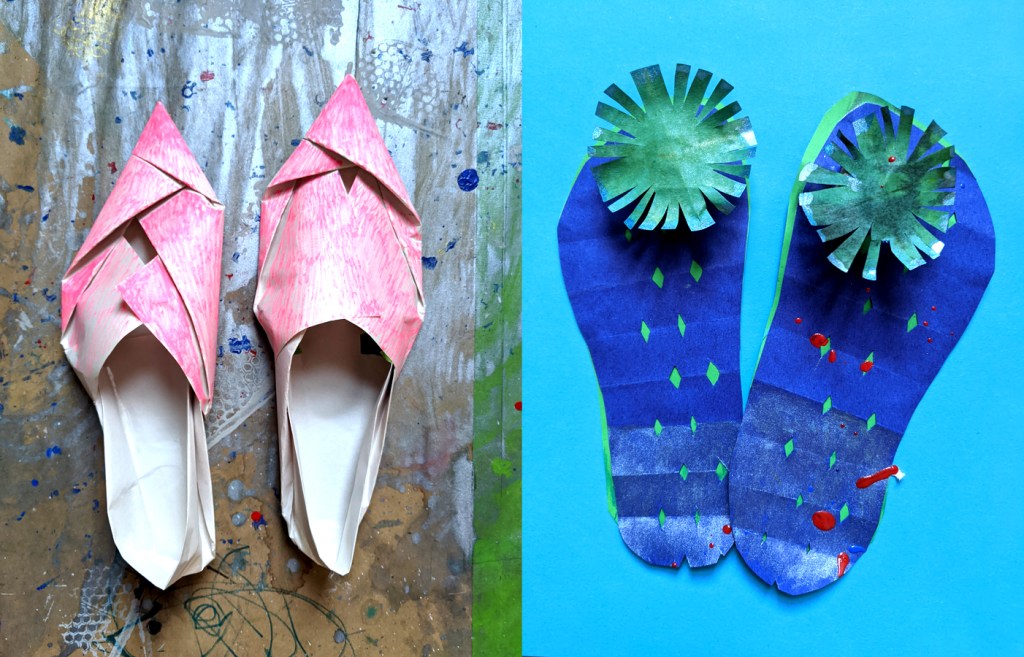
This interactive collage reflects on and draws inspiration from data visualizations Arlo watches on NOVA and his dreams about space travel across the multiverse. His ‘magical maps.’ are made from found photography, paper and paint and pretty much anything we have accumulated from recycled cardboard to milk cartons. Thoughtful brainstorms about non-competitive group play go into designing this and all of our projects, which are also based on past experiences at school that could have gone better. Taking turns is an important concept that materialized as wearable paper shoe, The magical shoes identify the player’s trajectory, and pin them to the map. Together the map and shoes delineate a space for retracing, enacting, or performing.
Not all of the skills required to complete this project are preferred, so I plan studio events that supplement and compliment Arlo’s skill sets. For example, he mixes the decoupage, while I cut out his favorite images. He draws and paints the circle and I cut it out. The process of collaborative making is a constant negotiation, with affirmative language that eventually inspired him to develop new techniques. Sometimes we both get distracted, which turns out to be a new project, or just hanging out. When the work is complete, only we know how long it took, and everything we learned from making it.
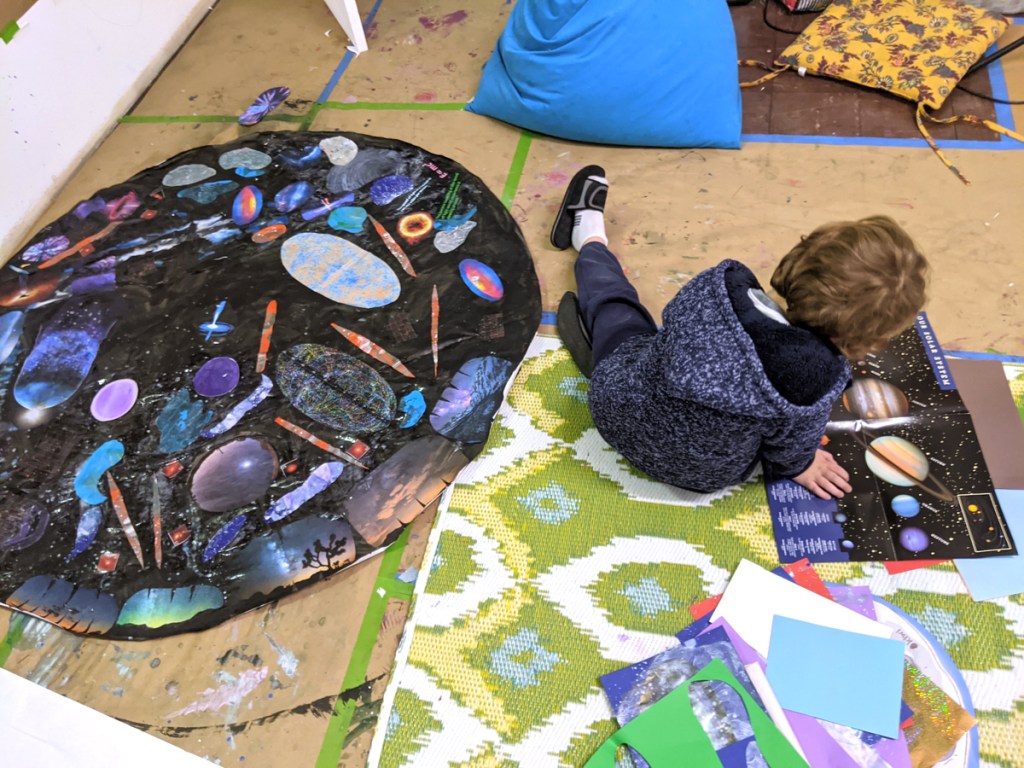
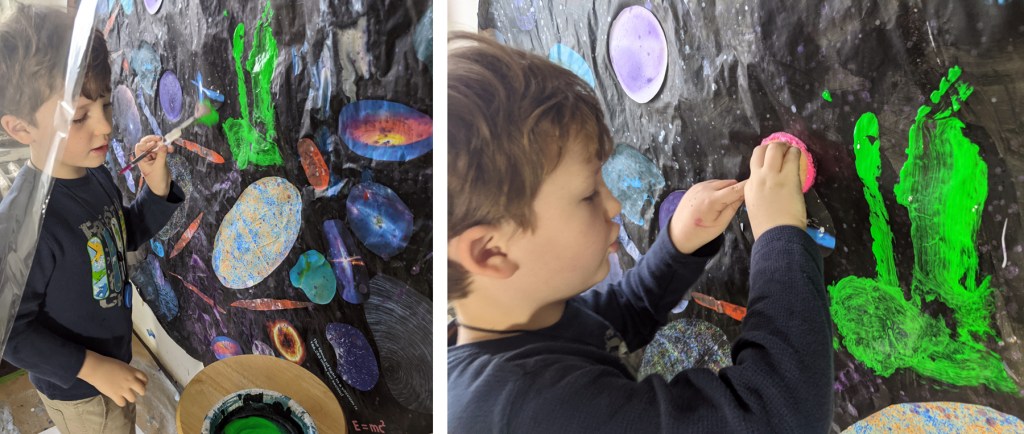
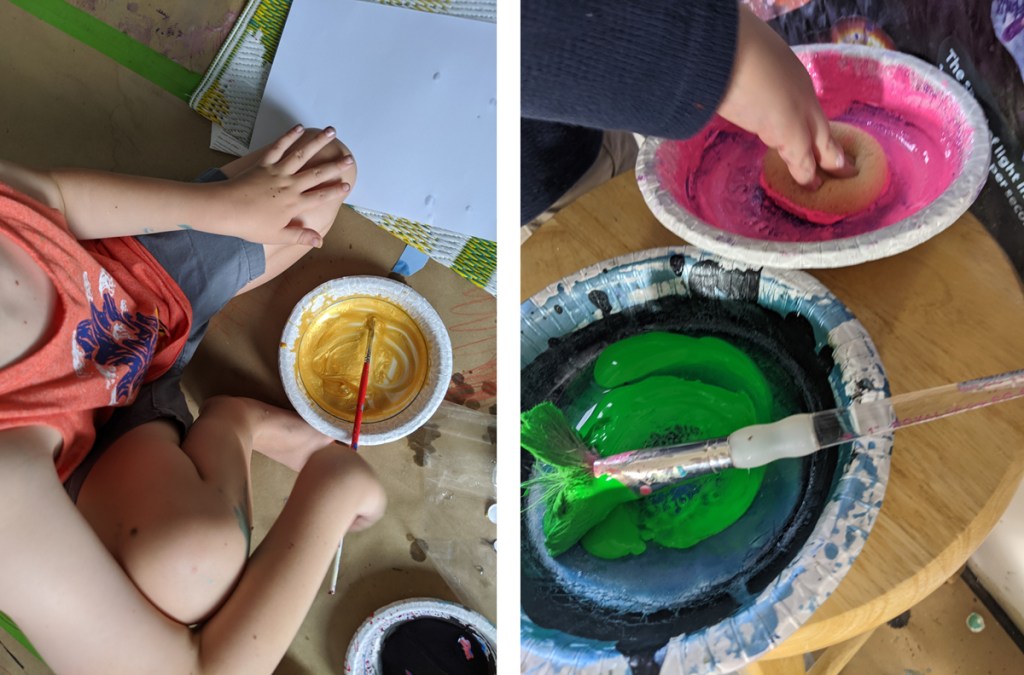
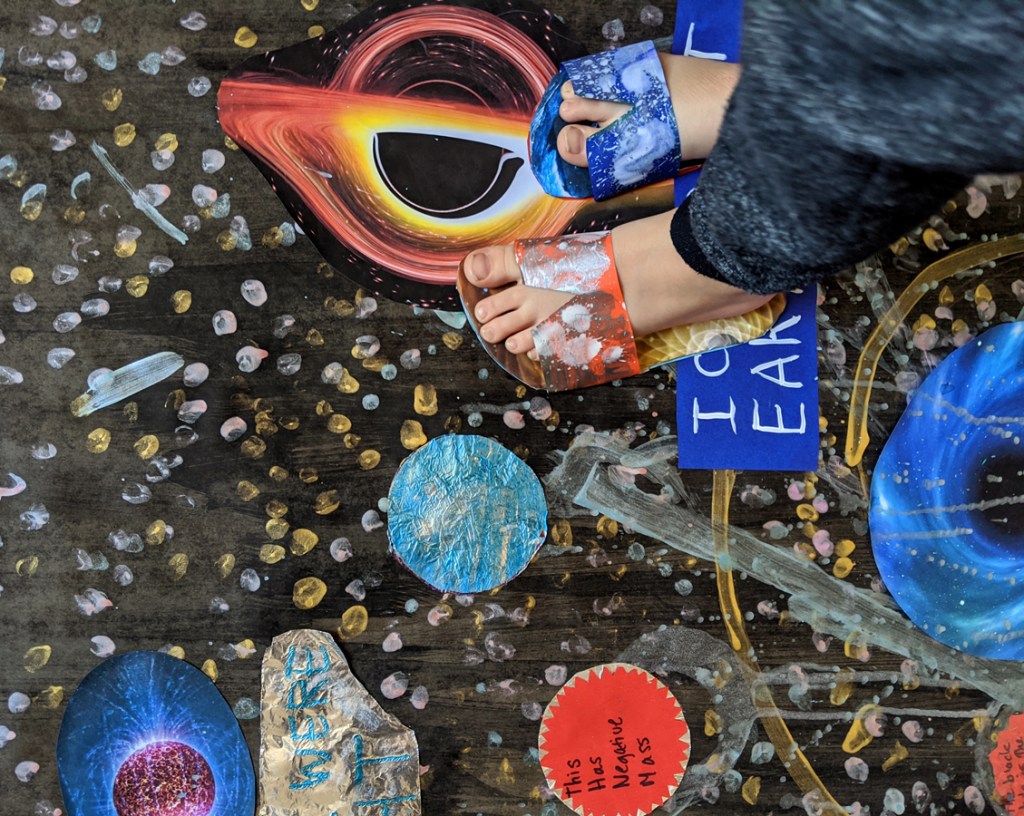
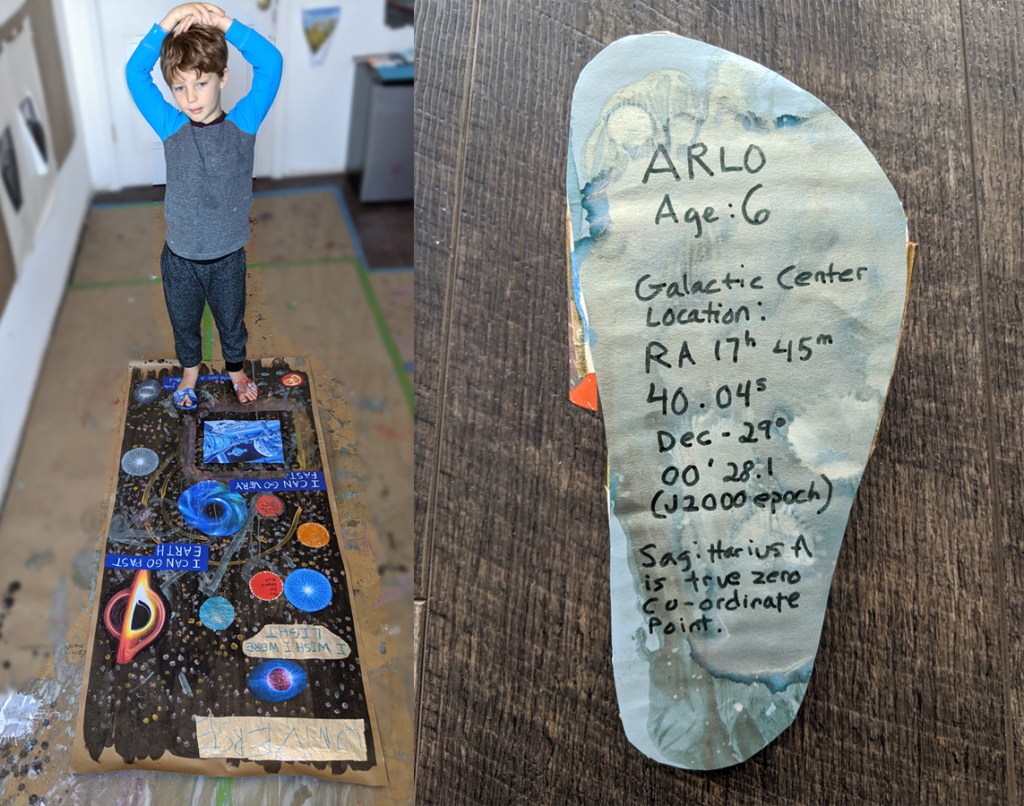
The first multiverse collage, or what Arlo calls a ‘mega collage’ was created vertically, on the wall. After Arlo spontaneously spoke a poem ‘I wish I was light’, we decided to integrate it into the collage as handwritten text. After discussing the desire to travel at the speed of light, Arlo thought of making a pair of shoes that could help him go this fast, I made the shoes from paper, and fit them to his feet. He painted them and then told me where he wanted them to take him, which I inscribed on the bottom.
Universe
By Arlo
I wish I were light
I can go past Earth
I can go very fast
In less than a second
Maybe even a millisecond
Creating instruction videos is a collage process. I recorded Arlo writing music about space travel, and used it as a soundtrack. I also recorded him writing the introduction credits, to build his confidence in reading and writing. If you look closely at the introduction credits, he traces on top of lightly dotted letters, a learning guide that comes in handy, especially when writing sentences. Layers of practice go into these collaborations, from both of us. The videos combine them into a cohesive artwork, and record that we can revisit and feel proud of.

If you are curious collaborating with your kids at home, here is a list of UDL tips that work in classrooms with multiple learners, as well as two-person collaborations:
The top five Universal Design for Learning tips for nurturing expert learners (that’s us!)
- Support goal setting. Arlo “wishes he was light” so we set out to reach his goals.
We created clarity around his goals and collaborated on purposeful and strategic learning.
We tried things out on a smaller scale, beginning with a painting of the galaxy he wants to explore. During this process, Arlo reflected on his personal experiences with space travel and astronomy.
2. Communicate high expectations for all learners.
Barriers appeared during this project due to external time expectations. We adjusted by working in the studio in shorter durations, and returning frequently (so as to not loose steam). Keeping the expectations high (dreaming big) gave us the momentum we needed to make something we hadn’t made before. We wanted to surprise ourselves and experience exploration on a human timescale.
3. Promote disciplinary expertise.
Before making any art, we have to develop competency with materials and techniques. Creating smaller things with lots of variation holds a space where experimentation can be woven throughout the project and accumulate into a larger outcome (which is exciting!) Some of the skills we developed with this project include working with scissors, collaging, and understanding basic ways to construct shoes or paper sandals.
4. Focus on the process, not just the outcome.
Staying focused is important and challenging, especially when Arlo and I have so many ideas, and can get lead off our path if we are not careful. These ideas are a good thing, and are indeed a part of the process. Opening the body to materials and processes unlocks the imagination. It is normal to have lots ideas about other projects while working, so find a way to make note of them, or talk about them with yourself or collaborator so they don’t get forgotten.
5. Guide self-reflection.
This final tip was touched on in the previous tip, but is key to shifting our thinking away from perceiving “mishaps” or unexpected results as mistakes. Even worse, when something doesn’t go the way we expect, we are prone to give on altogether. Working through these moments is important, even if this means taking a break.
 iwishiwaslight